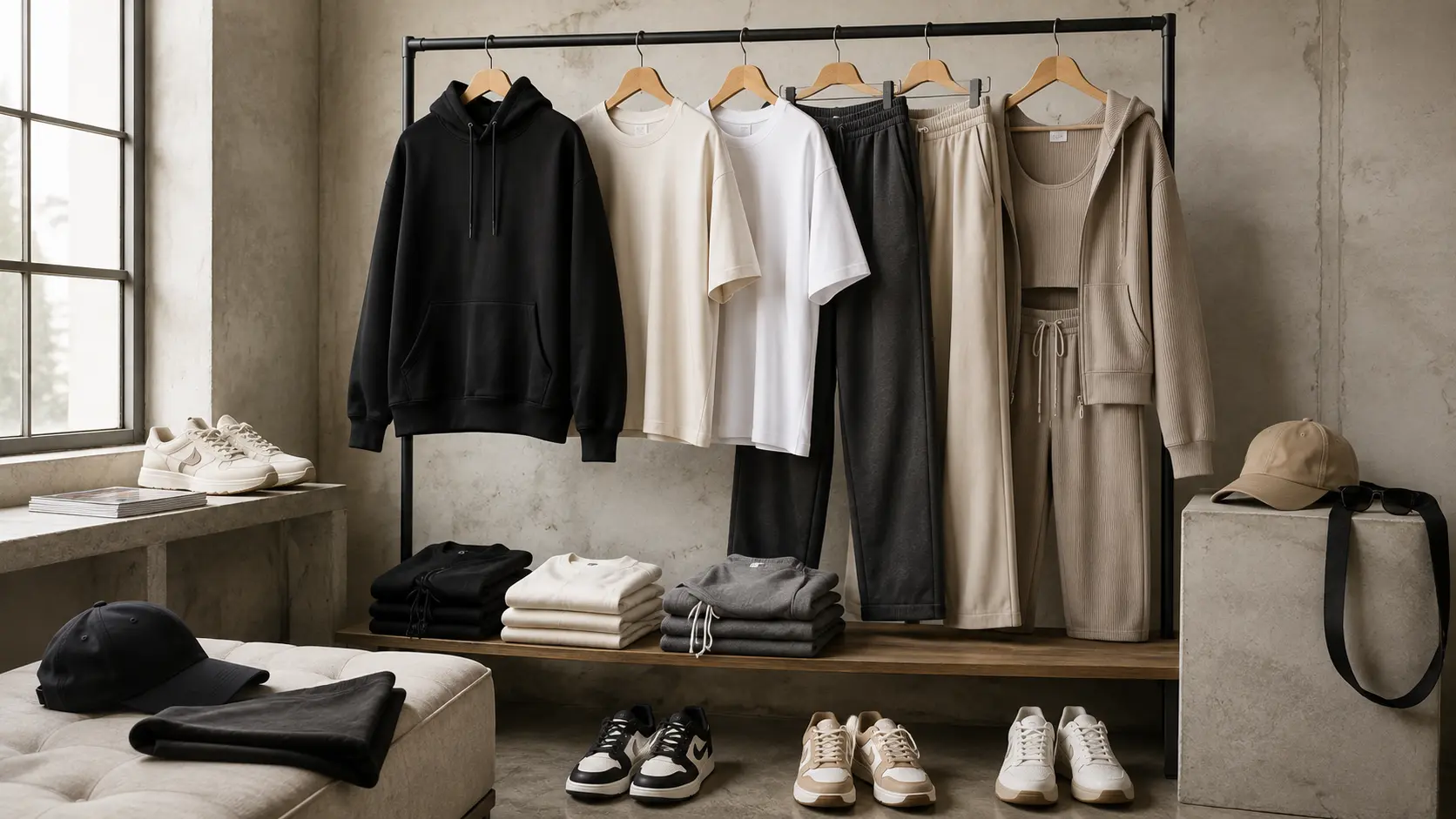
A good wardrobe does not need to contain hundreds of pieces.

In fact, having too many clothes can sometimes make getting dressed more difficult. When everything is competing for attention, it becomes harder to see which pieces actually work together.
A minimalist streetwear wardrobe takes a different approach.
Instead of collecting clothing without a plan, the focus is on versatile pieces that can be combined in several ways. A small selection of T shirts, hoodies, bottoms, and coordinated outfits can create a surprisingly large number of everyday looks.
Minimalism does not mean wearing only black or owning very little clothing.
It means being selective.
The goal is to build a wardrobe where most pieces have a purpose and can easily work with the rest of your clothing.
What Is a Minimalist Streetwear Wardrobe?
A minimalist streetwear wardrobe is a collection of casual clothing built around versatility, comfort, and consistency.
The wardrobe may include relaxed T shirts, oversized hoodies, casual bottoms, matching sets, sneakers, and a few carefully selected accessories.
The important part is how these pieces work together.
A minimalist wardrobe should make outfit selection easier.
You should be able to pick a T shirt, choose a pair of bottoms, add a hoodie when needed, and have a combination that already looks complete.
Why Minimalism Works With Streetwear
Streetwear is naturally suited to a simplified wardrobe.
Many streetwear staples are easy to combine.
A plain T shirt can work with almost any pair of bottoms.
A hoodie can be worn over different tops.
Relaxed bottoms can be paired with several silhouettes.
A matching set can be worn together or separately.
This means you can create variety without constantly buying new clothing.
The Leo Skepi Merch homepage is a useful starting point when exploring casual pieces that can become part of a versatile streetwear wardrobe.
Start With Your Lifestyle
Before buying anything, think about how you actually spend your time.
Do you mostly wear casual clothing?
Do you spend your days at university?
Do you work in a relaxed environment?
Do you travel frequently?
Do you spend weekends outdoors?
Your wardrobe should support your real lifestyle rather than an imaginary version of it.
Identify Your Most Common Outfits
Look at what you already wear.
You may notice that you repeatedly reach for the same T shirts, hoodies, and bottoms.
Those pieces are giving you useful information.
They show you what you actually like wearing.
Instead of fighting that pattern, build around it.
Choose a Consistent Color Palette
Color coordination is one of the easiest ways to simplify a wardrobe.
You do not need every item to be the same color.
Instead, choose several shades that naturally work together.
Black, white, grey, cream, brown, navy, beige, olive, and muted colors can provide a strong foundation.
You can then introduce stronger colors through selected statement pieces.
Why a Color Palette Helps
Imagine having six T shirts and four pairs of bottoms.
If most of the T shirts work with most of the bottoms, you already have many outfit combinations.
If every T shirt only works with one particular pair of bottoms, your wardrobe becomes less flexible.
A consistent palette increases the number of combinations available from fewer pieces.
Build Around T Shirts
T shirts should be one of the foundations of a minimalist streetwear wardrobe.
They are comfortable, versatile, easy to layer, and simple to pack.
A good collection does not require dozens of T shirts.
A few carefully selected designs can provide plenty of variety.
The T shirt collection can be incorporated into a minimalist wardrobe by choosing designs and colors that complement the pieces you already own.
Include Basic Colors
Neutral T shirts are useful because they work with almost everything.
White, black, cream, grey, and muted colors can form the foundation.
Add a Few Graphic Designs
Minimalism does not mean eliminating personality.
A graphic T shirt can act as a statement piece while the rest of the outfit remains simple.
One strong graphic can provide more visual interest than several complicated pieces.
Add Versatile Hoodies
A hoodie is another essential component of a casual streetwear wardrobe.
It can provide warmth, add another layer, and change the appearance of a simple T shirt and bottoms combination.
The hoodie collection can be useful when selecting pieces that fit into your preferred color palette and silhouette.
Choose Hoodies That Work With Multiple Outfits
A versatile hoodie should not depend on one particular pair of bottoms.
It should work with several options.
For example, a neutral hoodie could be worn with black bottoms, grey bottoms, denim, or lighter neutral shades.
This makes the garment much more useful.
Invest in Good Bottoms
T shirts and hoodies may receive most of the attention, but bottoms determine a large part of the overall silhouette.
A minimalist wardrobe should include bottoms that can support several different tops.
The bottoms collection can be used to explore relaxed and casual options for creating everyday combinations.
Choose Different Levels of Relaxed Fit
You do not need several pairs that all have exactly the same silhouette.
Consider having one pair with a more structured appearance and another with a relaxed fit.
This gives you more variety while keeping the wardrobe relatively small.
Do Not Ignore Matching Sets
Matching sets can make outfit planning extremely easy.
The colors and proportions are already coordinated, so you can put the outfit together quickly.
The women’s sets collection can provide coordinated options for a minimalist wardrobe.
Wear the Set Together
A matching set creates an instantly complete appearance.
It is useful when you want to get dressed quickly without thinking about individual color combinations.
Separate the Pieces
The real value of a set comes from its flexibility.
The top can be worn with other bottoms.
The bottoms can be paired with a T shirt or hoodie.
This creates additional outfits without adding many pieces to the wardrobe.
Choose Quality Over Quantity
Minimalism works best when the clothing you own gets regular use.
Buying several inexpensive garments that rarely leave your wardrobe does not create efficiency.
Instead, focus on pieces that you genuinely enjoy wearing.
Look at Construction
Pay attention to stitching, seams, fabric feel, and finishing.
You do not need to become a textile expert.
Simply examine whether the garment feels comfortable and appears capable of handling regular wear.
Think About Cost Per Wear
One useful way to evaluate clothing is cost per wear.
A garment that costs more but gets worn repeatedly may provide more value than a cheaper item that stays in the closet.
For example, a hoodie that you wear every week can become one of the most useful pieces in your wardrobe.
A trendy garment that only works with one outfit may receive very little use.
Avoid Buying Duplicate Pieces
If you already have several black hoodies that serve the same purpose, another black hoodie may not add much value.
Before buying something new, ask:
What does this add?
Can I create at least three outfits with it?
Does it work with my existing colors?
Would I actually wear it regularly?
These questions can prevent unnecessary purchases.
Keep a Few Statement Pieces
A minimalist wardrobe should not become boring.
One or two distinctive pieces can provide personality.
A colorful hoodie.
A graphic T shirt.
A unique pair of bottoms.
A coordinated set.
These pieces can become the focal point while the rest of the wardrobe remains simple.
Let Basics Support Statement Pieces
If you have a strong graphic T shirt, pair it with neutral bottoms.
If you have colorful bottoms, use a simpler top.
If you have a bold hoodie, keep the rest of the outfit understated.
This makes the statement piece more effective.
Understand the Role of Neutrals
Neutral colors are powerful because they connect different parts of your wardrobe.
A black pair of bottoms can work with almost any color.
A cream T shirt can work with dark or light bottoms.
Grey can bridge warm and cool shades.
Brown can work with earth tones.
Navy can replace black when you want something slightly softer.
A minimalist wardrobe becomes much easier to manage when several of these colors are present.
Use Layering to Create Variety
A small wardrobe can create many outfits through layering.
A T shirt can be worn alone.
Add a hoodie when it becomes cooler.
Wear a jacket over the hoodie.
Change the bottoms.
Change the sneakers.
The base clothing remains the same, but the overall appearance changes.
Keep Layers Compatible
When buying layers, think about how they fit together.
A very thick hoodie may not work beneath certain jackets.
A long T shirt may create a useful layered hem beneath a shorter hoodie.
A neutral outer layer can work with several different colors.
Planning these relationships makes layering easier.
Create an Everyday Outfit Formula
A simple outfit formula can save time.
For example:
T shirt + relaxed bottoms + sneakers.
Or:
T shirt + hoodie + relaxed bottoms + sneakers.
Another option might be:
Matching set + sneakers + simple accessory.
The exact formula depends on your style.
The purpose is to create combinations you can rely on.
Keep Your Favorite Pieces Accessible
If you wear certain garments frequently, keep them easy to reach.
There is little benefit in owning versatile clothing if it is buried underneath pieces you rarely use.
Organize your wardrobe around frequency of use.
Separate Seasonal Pieces
Heavy winter layers do not need to occupy the most accessible space during warm weather.
Likewise, lightweight summer clothing can be stored away during colder months.
This makes your everyday wardrobe easier to navigate.
Learn the Difference Between Minimal and Plain
Minimal does not mean plain.
A minimalist outfit can still contain graphics, texture, color, and interesting proportions.
The difference is that each element has a purpose.
A graphic T shirt can provide the visual focus.
A hoodie can add shape.
Relaxed bottoms can create the silhouette.
Sneakers can finish the outfit.
Nothing needs to compete unnecessarily.
Use Proportion to Create Interest
When colors are simple, proportions can make an outfit more visually interesting.
An oversized hoodie with straight bottoms creates one silhouette.
A shorter T shirt with wide bottoms creates another.
A longer T shirt underneath a hoodie creates another.
You can create variety without introducing additional colors.
Experiment With Oversized Pieces
Oversized clothing can fit naturally into a minimalist wardrobe.
An oversized hoodie can become a reliable outer layer.
An oversized T shirt can work with several pairs of bottoms.
The important thing is to choose proportions that feel intentional.
Avoid Excessive Volume Everywhere
If every garment is extremely oversized, the outfit can lose definition.
Try combining one very relaxed piece with another piece that has slightly more structure.
This creates balance.
Choose Footwear Carefully
You do not need a huge sneaker collection.
A few versatile pairs can cover most casual situations.
A neutral sneaker can work with almost everything.
A darker sneaker can provide contrast.
A distinctive sneaker can serve as a statement piece.
Think About Your Clothing Colors
If your wardrobe contains mostly neutral shades, you can introduce color through footwear.
If your clothing already contains several strong colors, neutral sneakers may make more sense.
Accessories Should Serve a Purpose
Minimalist dressing does not require eliminating accessories.
The goal is to avoid unnecessary clutter.
A cap, watch, bag, sunglasses, or simple jewelry can add personality.
Choose accessories that you genuinely use.
Use Accessories to Repeat Colors
Accessories can also connect colors across an outfit.
A brown bag can complement brown footwear.
A cap can repeat a color from a graphic T shirt.
These small details can make an outfit feel coordinated.
Keep Your Wardrobe Flexible
One of the biggest advantages of minimalism is flexibility.
You should be able to change plans without needing to completely change your clothing.
A comfortable outfit should work for a casual lunch.
A hoodie should work for an evening walk.
A T shirt should work for a relaxed social gathering.
Versatility gives you freedom.
Build Around Your Favorite Silhouette
Everyone has certain shapes they naturally prefer.
Some people like oversized hoodies and relaxed bottoms.
Others prefer a more balanced silhouette with moderately loose clothing.
Some prefer wide trousers with shorter tops.
Others prefer longer layers.
Identify what you enjoy wearing and build around it.
Do Not Follow Every Trend
Streetwear changes constantly.
New colors, silhouettes, graphics, and combinations appear every season.
You do not need to adopt every trend.
A minimalist wardrobe should be based on what works for you.
Add Trends Selectively
If you genuinely like a new trend, introduce one piece rather than replacing your entire wardrobe.
This allows you to experiment without losing the consistency of your existing clothing.
Review Your Wardrobe Regularly
Every few months, look at what you actually wear.
Some garments will naturally become favorites.
Others may remain untouched.
Ask yourself why.
Maybe the fit is uncomfortable.
Maybe the color does not work with anything else.
Maybe the garment simply does not match your lifestyle.
This information can improve future purchases.
Remove Clothing You Never Wear
A minimalist wardrobe becomes difficult to maintain when it is filled with unused pieces.
If you have not worn something for a long time and have no realistic plan to wear it, consider whether it deserves space in your wardrobe.
The goal is not to own as little as possible.
The goal is to own what you actually use.
Keep Seasonal Flexibility
A minimalist wardrobe should still handle changing temperatures.
During warm weather, T shirts can become the primary layer.
When temperatures drop, hoodies become useful.
In colder weather, additional outer layers can be added.
This allows the same basic wardrobe to work across different seasons.
Think About Travel
A minimalist wardrobe is particularly useful when traveling.
Fewer pieces mean less luggage.
If your clothing follows a consistent color palette, you can create multiple combinations from a small selection.
T shirts can be layered.
Hoodies can provide warmth.
Relaxed bottoms can work for long travel days.
Matching sets can provide an easy complete outfit.
The same principles that make everyday dressing easier can make packing easier too.
Create a Small Capsule Collection
You can think of your wardrobe as a capsule collection.
For example, you might have:
Four or five T shirts.
Two or three hoodies.
Three pairs of versatile bottoms.
One coordinated set.
Two pairs of sneakers.
A small number of accessories.
The exact number is not important.
What matters is that the pieces work together.
Make Every Piece Earn Its Place
A useful question is:
Would I miss this garment if it disappeared tomorrow?
If the answer is no, it may not be an important part of your wardrobe.
This does not mean every garment must be worn constantly.
Special occasion pieces can have value too.
But everyday clothing should generally earn its space through regular use.
Keep Comfort at the Center
Streetwear is closely connected with comfort.
Do not sacrifice comfort simply because a particular outfit looks good in photographs.
You should be able to walk, sit, travel, and move naturally.
A comfortable T shirt and relaxed bottoms may become more useful than a complicated outfit you constantly need to adjust.
Pay Attention to Fit
Minimalist clothing needs to fit well because there are fewer pieces competing for attention.
A poorly fitting hoodie can affect the entire outfit.
A T shirt that is too long may change your proportions.
Bottoms that are too loose or too tight can affect the silhouette.
Choose the fit that matches your personal style.
Keep Your Clothes in Good Condition
A minimalist wardrobe works best when the pieces look their best.
Wash garments according to their care instructions.
Avoid unnecessary stretching.
Store clothing appropriately.
Repair small issues when practical.
Clean your sneakers regularly.
When you own fewer pieces, each garment may receive more frequent use, so proper care becomes even more important.
Build Outfits Before Buying More
Before purchasing something new, try creating several outfits from what you already own.
You may discover combinations you had never considered.
A T shirt that seemed limited might work perfectly with another pair of bottoms.
A hoodie might work with more colors than you expected.
A matching set might produce several separate outfits.
Sometimes the answer is already in your wardrobe.
Shop With a Purpose
When you decide that you need something new, know what role it needs to fill.
Maybe you need a neutral hoodie.
Maybe you need relaxed bottoms.
Maybe your wardrobe needs another T shirt.
Maybe you want one statement piece.
Having a purpose makes shopping more intentional.
Create a Wardrobe That Reflects You
Minimalism should never mean copying someone else’s wardrobe.
Your clothing should reflect your preferences.
If you love graphics, include graphic T shirts.
If you prefer neutral colors, build around them.
If you enjoy colorful hoodies, use them as statement pieces.
If coordinated sets make dressing easier, include them.
Minimalism is about reducing unnecessary choices, not removing personality.
A Simple Minimalist Streetwear Checklist
Before considering your wardrobe complete, check whether you have:
A selection of versatile T shirts.
At least one reliable hoodie.
Several bottoms that work with different tops.
A coordinated set if it suits your style.
Comfortable everyday footwear.
A consistent color palette.
A few accessories.
Enough clothing for your normal weekly routine.
Pieces suitable for different temperatures.
Clothing that you genuinely enjoy wearing.
You do not need to follow a fixed number.
Your wardrobe should match your lifestyle.
Final Thoughts
A minimalist streetwear wardrobe is not about owning the fewest clothes possible.
It is about making every piece more useful.
The strongest wardrobes are often built around versatile T shirts, dependable hoodies, comfortable bottoms, coordinated sets, and a color palette that makes mixing and matching easy.
Start with what you already wear.
Identify your favorite silhouettes.
Choose colors that work together.
Add statement pieces selectively.
Avoid buying duplicates that serve the same purpose.
Think about cost per wear.
Take care of the clothes you already own.
Most importantly, create a wardrobe that supports your actual lifestyle.
The Leo Skepi Merch homepage can be explored when looking for casual streetwear pieces that fit naturally into a versatile wardrobe.
The T shirt collection can provide everyday foundations, while the hoodie collection can add warmth and layering options. The bottoms collection can help build reliable combinations, while the women’s sets collection can provide coordinated outfits that require very little styling effort.
A wardrobe does not become better simply because it becomes bigger.
It becomes better when the pieces work together.
When you can open your wardrobe, choose almost any top and find several bottoms that work with it, you have created something genuinely practical.
When your favorite hoodie works with multiple T shirts and bottoms, it becomes more than another garment.
It becomes part of your personal uniform.
That is the real strength of minimalist streetwear.
It gives you fewer unnecessary decisions while leaving plenty of room for individuality.