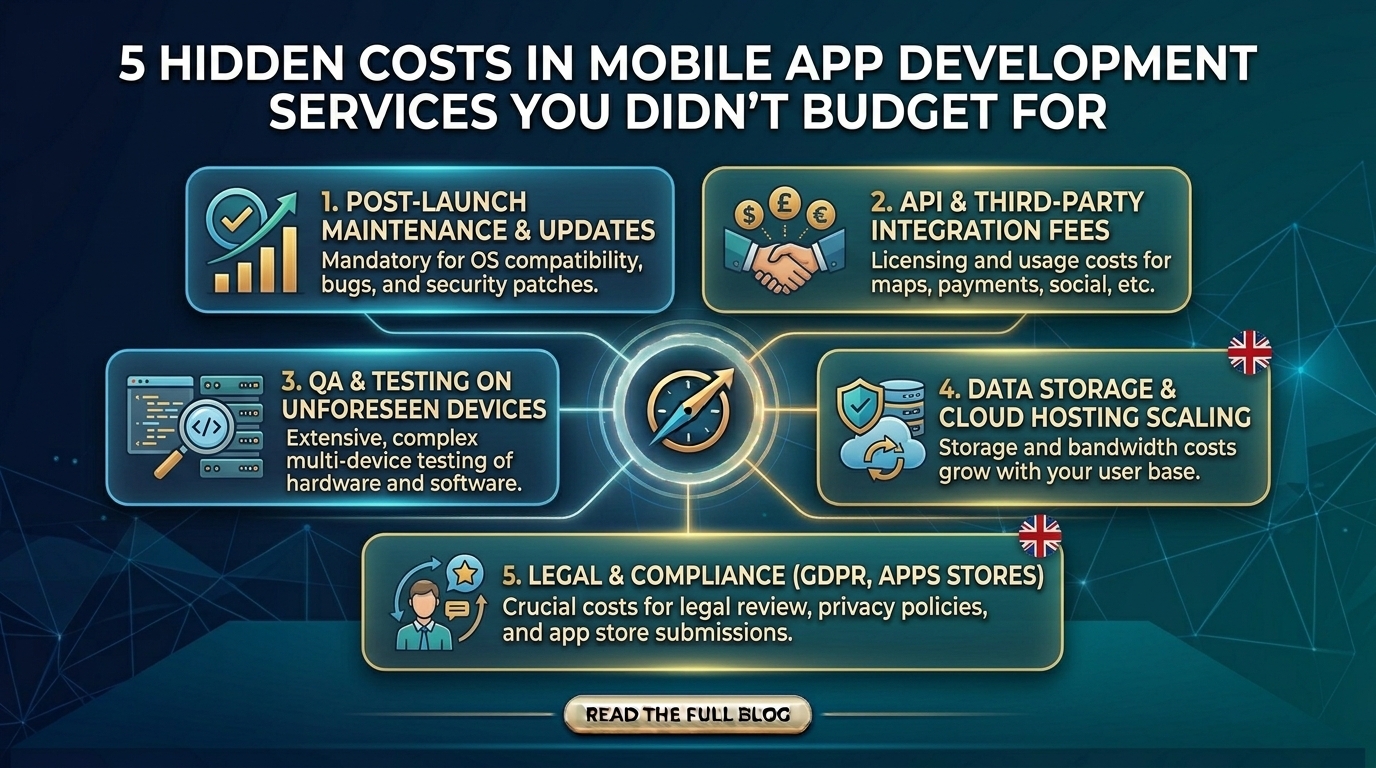
The five most common hidden costs in mobile app development are: scope creep from unplanned feature requests, third-party integration and API fees that continue after launch, post-launch maintenance and hosting, compliance and data protection work, and design/UX rework after real users test the product. Together, these can add 25–40% on top of the original development quote in the first year alone. Most agency quotes cover build cost only — not what it takes to run, secure, and refine the app afterward.

Key takeaways:
- A £50,000 build typically costs an extra £12,500–£20,000 in year-one maintenance and hosting
- Third-party APIs (payments, SMS, maps) are usage-based, not one-off costs
- Compliance work scales with what data your app touches — GDPR, PCI-DSS, or child-safety rules
- A 15–20% contingency budget for scope changes prevents most mid-project cost shocks
- Ask any agency for a post-launch cost breakdown, not just a build quote, before signing
What Counts as a “Hidden Cost” in App Development?
A hidden cost isn’t a cost the agency is trying to conceal in most cases it’s simply a cost that falls outside the scope of a development quote by definition. A build quote covers the engineering hours to design, code, and test a defined feature set. It typically does not cover what happens to that app in the months and years after it ships: subscriptions, legal review, server bills, and the inevitable changes that come from watching real users interact with the product.
Understanding this distinction matters more than memorizing a list, because it tells you what to ask for in any quote: not just “what does this cost to build,” but “what does this cost to build, run, and maintain for 12 months.”
The 5 Hidden Costs, Explained
1. What is scope creep, and why does it increase app development costs?
Scope creep is when new features or changes get added to a project after development has already started, outside the original agreed specification. It’s the single most common source of cost overruns in software projects generally, not just apps.
It happens because most founders don’t fully know what they want until they see a working prototype. Once a clickable build exists, requests like social login, an admin dashboard, or offline mode start appearing — each reasonable on its own, but collectively expensive because they interrupt planned development sprints. Agencies typically bill change requests at a premium rate specifically because of this disruption.
How to budget for it:
- Lock a detailed feature specification before development starts, not during
- Get the agency’s change-request rate card in writing up front
- Set aside 15–20% of your total budget specifically for scope changes
2. Do third-party integrations add ongoing costs after launch?
Yes. Development time to integrate a payment gateway, mapping service, or SMS/email verification tool is usually included in a build quote — but the ongoing subscription or usage-based fee for that service is a separate, recurring bill the agency doesn’t control.
Industry pricing guides consistently list the number of third-party integrations as one of the largest drivers of total app development cost in the UK, alongside feature count and platform requirements. A single payment integration might cost a fraction of a percent per transaction at launch — and scale into thousands of pounds a month as usage grows.
Commonly missed recurring line items:
- Payment processing fees (percentage-based, not flat)
- SMS/email verification services
- Maps and geolocation API usage
- Push notification infrastructure at scale
3. How much does app maintenance cost after launch?
Plan for 25–40% of the original build cost per year in ongoing maintenance, hosting, and support. Industry analysis of UK app projects shows maintenance, hosting, compliance, and support consistently adding this much to total cost of ownership after launch — meaning a £50,000 build can realistically cost £12,500–£20,000 annually just to keep running.
This covers OS compatibility updates (Apple and Google both push major releases yearly), security patching, bug fixes, server/cloud costs, and app store re-submissions. None of it is optional if you want the app to keep working.
Questions to ask before signing:
- Does “support” mean bug fixes only, or feature updates too?
- Who absorbs the cost when iOS/Android release a new OS version?
- Is hosting billed separately, and by whom — the agency or a cloud provider directly?
4. What compliance costs are missed in app development quotes?
Any app that collects user data is subject to UK GDPR, and quotes rarely itemise the legal and technical work this requires — a compliant privacy policy, a documented data-handling process, and in regulated sectors, specialist legal review.
This scales sharply by audience and industry. Apps aimed at users under 13, for instance, trigger additional child-specific compliance requirements (in the UK, the Age Appropriate Design Code) that require specialised legal input most general app quotes never account for. Fintech and healthtech apps face similarly specific overhead — PCI-DSS for payment handling, or clinical safety standards for health data.
Budget for:
- A GDPR-compliant privacy policy and data audit
- Legal review for regulated sectors (finance, health, children’s products)
- Penetration testing before major releases, especially if handling payment or health data
5. Why does UX and design rework add unexpected cost?
Because static design mockups don’t reveal how real users actually behave. A Figma prototype can look complete while still hiding navigation confusion, poorly designed forms, or accessibility gaps that only surface once real users start using an early build.
Fixing usability issues after screens are already coded is more expensive than designing around them early, because it means reworking built functionality rather than adjusting a flat design file. A fixed design phase with no allowance for iteration doesn’t eliminate this cost — it just defers it to after launch, when it’s more expensive to fix.
Smarter budgeting:
- Confirm whether the quote includes a round of usability testing with real users
- Agree a fixed number of design revision cycles up front, not open-ended “polish”
- Treat accessibility (WCAG 2.2) as a design requirement from day one, not a retrofit
Total Cost of Ownership: What a £50,000 Build Actually Costs
| Cost category | Typical range (Year 1) |
|---|---|
| Initial development (mid-complexity app) | £40,000 – £100,000+ |
| Scope change contingency (15–20%) | £6,000 – £20,000 |
| Third-party API/integration fees (annual) | £1,000 – £10,000+ (usage-dependent) |
| Maintenance, hosting & support (25–40% of build) | £10,000 – £40,000 |
| Compliance & legal review | £1,500 – £15,000+ (sector-dependent) |
| Post-launch UX iteration | £2,000 – £10,000 |
These are indicative UK ranges based on published 2026 agency pricing data; actual figures depend heavily on app complexity, sector, and team location. London-based agencies typically price 15–25% above regional UK studios for comparable scope.
What App Founders Actually Say About This
Across founder communities like Indie Hackers, r/startups, and app-development subreddits, a consistent pattern shows up when people discuss their first app build: the build itself rarely blows the budget — the months after launch do. Common threads include:
- Founders who budgeted only for development being caught off guard by cloud hosting bills that scaled with user growth
- Repeated complaints about “support contracts” that turned out to cover bug fixes only, not the feature requests founders assumed were included
- Multiple accounts of compliance requirements (particularly GDPR-related data audits) surfacing only after an investor or enterprise client asked for documentation the team didn’t have
The pattern is less “agencies are dishonest” and more “founders don’t ask about total cost of ownership until it’s too late.” Asking for a 12-month cost projection — not just a build quote — is the single change that shows up most often in after-the-fact advice from people who’d been through it.
Fixed Price vs. Time & Material: Which Hides More Costs?
Fixed price contracts quote a set fee for a defined scope. They protect you from cost overruns within that scope, but any change outside it is billed separately — often at a premium, which is where most “hidden cost” complaints originate.
Time & material contracts bill for actual hours worked. They’re more transparent about where money goes but carry more budget-management risk if scope isn’t tightly controlled from your side.
Neither model eliminates hidden costs — they just shift where the risk sits. Fixed price hides risk in the change-request process; time & material hides risk in scope discipline.
Frequently Asked Questions
What is the average total cost of a mobile app in the UK, including hidden costs? For a mid-complexity business app, expect the development quote plus an additional 25–40% for first-year maintenance, hosting, and support. A £50,000 build often means £62,500–£70,000 in true first-year cost once these are included.
Are hidden costs a sign of an untrustworthy development agency? Not inherently — many hidden costs (App Store fees, cloud hosting, compliance work) are unavoidable industry realities, not agency markups. The warning sign is an agency that won’t discuss post-launch costs directly when asked during scoping.
Can scope creep be avoided entirely? Not entirely, but it can be minimised. A detailed functional specification agreed before development starts, combined with a pre-agreed change-request rate, are the two most effective safeguards against runaway scope costs.
Do I need a UK-based agency for GDPR compliance? Not strictly — an offshore team can build a GDPR-compliant app — but a UK-based or UK-experienced team typically has more direct familiarity with ICO guidance and app store regional data requirements, which reduces compliance risk.
How much should I budget annually for app maintenance after launch? As a working rule, set aside 15–20% of the original development cost per year for maintenance, OS compatibility updates, and minor feature work — higher if the app processes payments or sensitive personal data.
Is a fixed-price quote safer than time & material for avoiding hidden costs? Neither model removes hidden costs outright. Fixed price protects against overruns within the agreed scope but bills changes separately, often at a premium. Time & material is more transparent about hourly spend but requires tighter scope discipline from the client side.
What’s the single most effective way to avoid being surprised by hidden costs? Ask for a 12-month total cost of ownership estimate — not just a build quote — before signing. This single question surfaces most maintenance, hosting, and compliance costs that standard proposals leave out.
Key Takeaways
- Hidden costs aren’t concealed costs — they’re costs that fall outside a standard build quote by definition
- Budget 25–40% above your development quote for realistic first-year total cost of ownership
- The most common blind spots are maintenance, third-party API fees, compliance, and post-launch UX fixes
- Ask any prospective developer for a 12-month cost projection, not just a build price, before signing a contract
This guide reflects 2026 UK market pricing data and is reviewed periodically as agency benchmarks update.